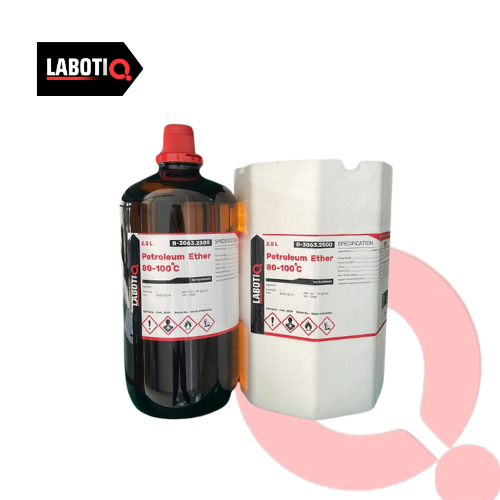
Petroleum ether is the petroleum fraction consisting of aliphatic hydrocarbons and boiling in the range 35–60 °C, and commonly used as a laboratory solvent. Despite the name, petroleum ether is not an ether; the term is used only figuratively, signifying extreme lightness and volatility.The very lightest, most volatile liquid hydrocarbon solvents that can be bought from laboratory chemical suppliers may also be offered under the name petroleum ether. Petroleum ether consists mainly of aliphatic hydrocarbons and is usually low on aromatics. It is commonly hydrodesulfurized and may be hydrogenated to reduce the amount of aromatic and other unsaturated hydrocarbons. Petroleum ether bears normally a descriptive suffix giving the boiling range. Thus, from the leading international laboratory chemical suppliers it is possible to buy various petroleum ethers with boiling ranges such as 30–50 °C, 40–60 °C, 50–70 °C, 60–80 °C, etc. In the United States, laboratory-grade aliphatic hydrocarbon solvents with boiling ranges as high as 100–140 °C may be called petroleum ether, rather than petroleum spirit.It is not advisable to employ a fraction with a wider boiling point range than 20 °C, because of possible loss of the more volatile portion during its use in recrystallisation, etc., and consequent different solubilising properties of the higher boiling residue.