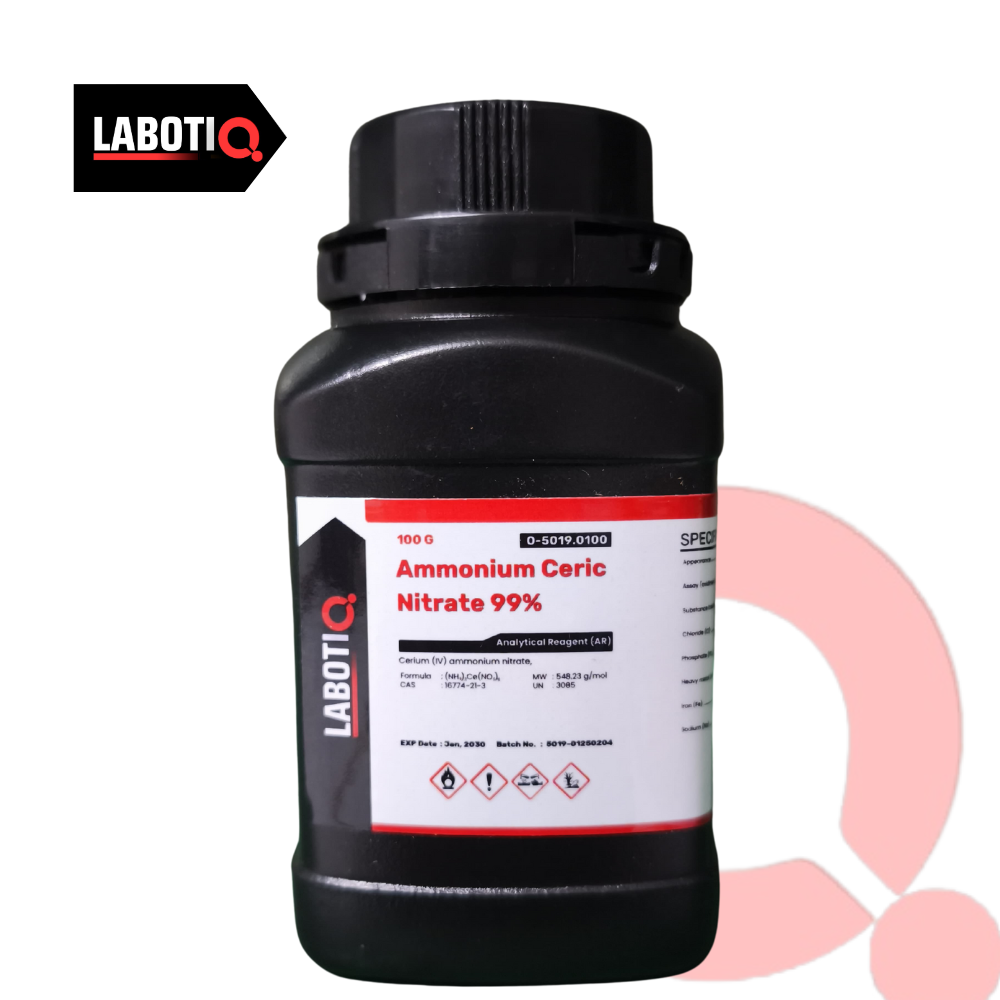
In organic synthesis, CAN is useful as an oxidant for many functional groups (alcohols, phenols, and ethers) as well as C–H bonds, especially those that are benzylic. Alkenes undergo dinitroxylation, although the outcome is solvent-dependent. Quinones are produced from catechols and hydroquinones and even nitroalkanes are oxidized.
CAN is also a component of chrome etchant, a material that is used in the production of photomasks and liquid crystal displays. It is also an effective nitration reagent, especially for the nitration of aromatic ring systems. In acetonitrile, CAN reacts with anisole to obtain ortho-nitration products
TINDAKAN PENCEGAHAN UNTUK PENANGANAN YANG AMAN
a. Saran tentang penanganan yang aman
Kenakan pakaian pelindung.
b. Saran tentang perlindungan terhadap kebakaran dan ledakan
Jauhkan dari nyala terbuka, permukaan panas, dan sumber penyulut.
c. Tindakan kebersihan
Segera ganti pakaian yang terkontaminasi. Gunakan krim pelindung kulit. Cuci tangan dan muka setelah bekerja dengan bahan tersebut. Untuk tindakan pencegahan lihat bagian 2.2 dalam SDS
KONDISI PENYIMPANAN YANG AMAN, TERMASUK KETIDAKCOCOKAN
a. Kondisi penyimpanan
Wadah yang tidak mengandung logam.Tertutup sangat rapat. Jangan gunakan dekat bahan-bahan yang mudah Terbakar. Menyimpan di bawah gas inert. higroskopik
Suhu penyimpanan : rekomendasi suhu penyimpanan lihat label
b. Kelas penyimpanan
Kelas penyimpanan Jerman (TRGS 510): 5.1B: Bahan berbahaya yang mengoksidasi

Your orders are shipped seamlessly between countries

Your orders are shipped seamlessly between countries

You have the right to return your orders within 30 days.

0251-8359110 (Call)
+62 813 1689 4650 (WA)
+62 8953 6506 8181 (WA)
Webdeveloper.id menyediakan Powered by jasa pembuatan website professional Webdeveloper.id