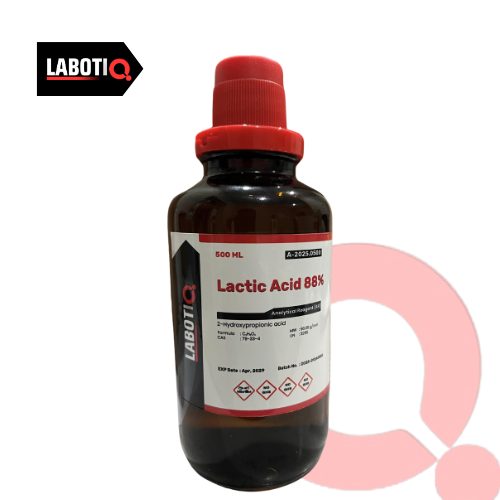
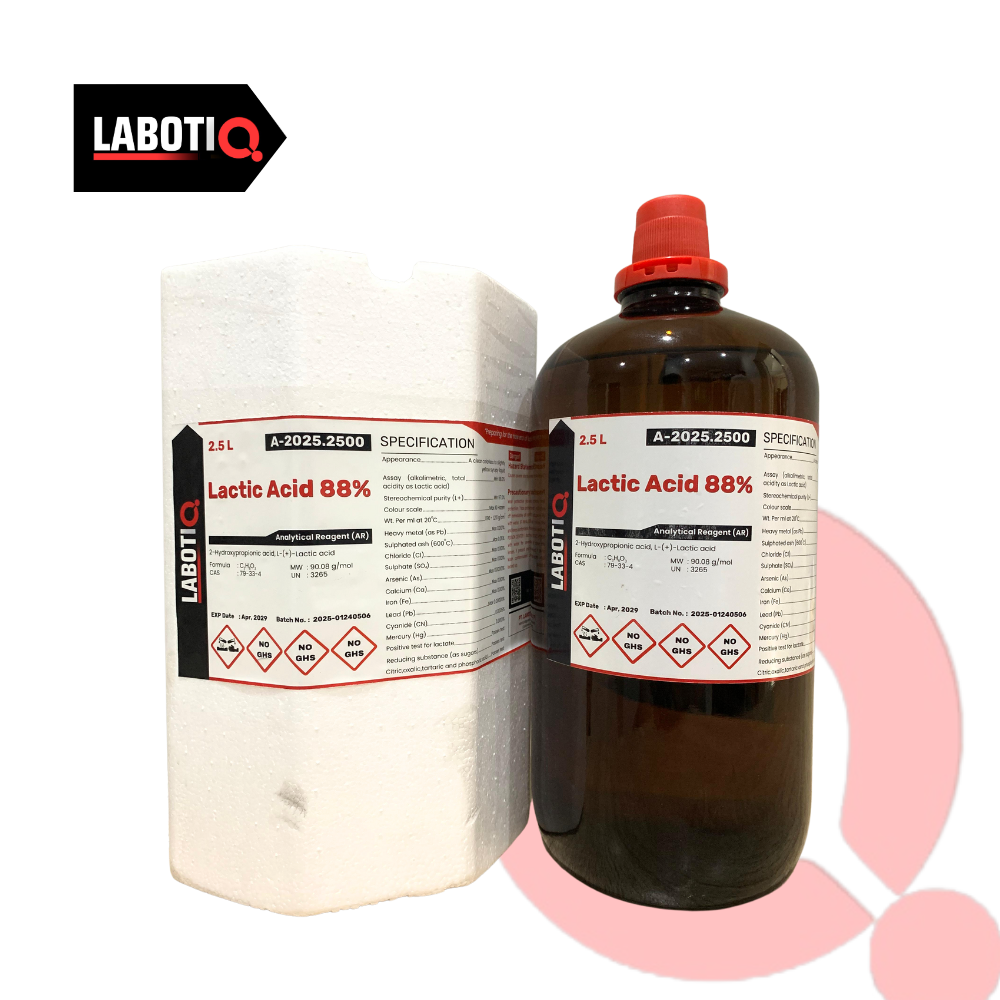
Lactic acid is an organic acid. It has the molecular formula C3H6O3. It is white in the solid state and it is miscible with water. When in the dissolved state, it forms a colorless solution. Production includes both artificial synthesis as well as natural sources. Lactic acid is an alpha-hydroxy acid (AHA) due to the presence of a hydroxyl group adjacent to the carboxyl group. It is used as a synthetic intermediate in many organic synthesis industries and in various biochemical industries. The conjugate base of lactic acid is called lactate (or the lactate anion). The name of the derived acyl group is lactoyl.Lactic acid is chiral, consisting of two enantiomers. One is known as L-lactic acid, (S)-lactic acid, or (+)-lactic acid, and the other, its mirror image, is D-lactic acid, (R)-lactic acid, or (−)-lactic acid. A mixture of the two in equal amounts is called DL-lactic acid, or racemic lactic acid. Lactic acid is hygroscopic. DL-Lactic acid is miscible with water and with ethanol above its melting point, which is about 16 to 18 °C (61 to 64 °F). D-Lactic acid and L-lactic acid have a higher melting point.